Publications
2026
- PREPRINT
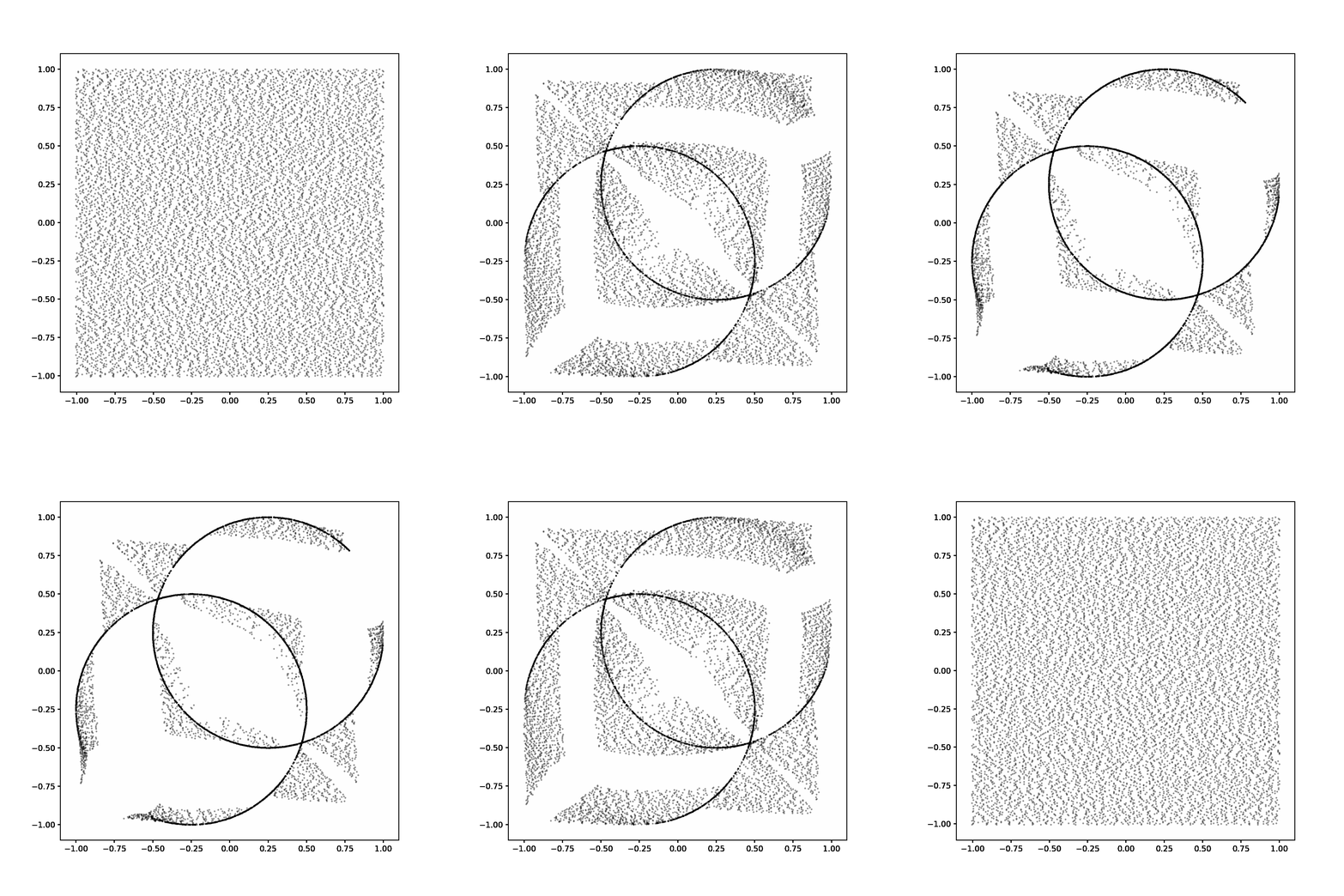 Statistical Estimation of Monge Transport Maps via Brenier PotentialsElsa Cazelles, Edouard Pauwels, and Léo PortalesApr 2026
We introduce and analyze a statistical estimator for Monge transport maps: solutions to the quadratic optimal transport problem in Euclidean space. For absolutely continuous source measures, this map is uniquely defined as the gradient of a convex function, a result known as Brenier’s theorem. Without absolute continuity, the problem is relaxed, maps are replaced by coupling measures, and optimal couplings are supported on the subdifferential of a convex function, a Brenier potential. This characterization is the basis for our statistical estimator of Monge transport maps for measures known only through finite samples. The resulting Brenier potential has a simple closed-form expression based on the dual solution of the discrete sampled problem. In particular, our methodology does not rely on smoothness or continuity of the Monge transport map and requires no computation beyond primal-dual solutions of the discrete finite-dimensional problem. We exhibit convergence rates for this estimator based on a new error bound for the quadratic optimal transport problem. In the semi-discrete setting, where the target measure is finitely supported, our estimator enjoys sharper convergence rates. Finally, using similar proof techniques, we provide a novel convergence rate for empirical couplings.
@article{portales2026StatisticalEstimationofMongeTransportMapsviaBrenierPotentials,
  title = {Statistical Estimation of Monge Transport Maps via Brenier Potentials},
  author = {Cazelles, Elsa and Pauwels, Edouard and Portales, Léo},
  year = {2026},
  month = apr,
  publisher = {Arxiv},
  eprint = {2604.22366},
  archiveprefix = {arXiv},
  primaryclass = {PREPRINT},
}
2025
- PREPRINT
 Sample complexity of optimal transport barycenters with discrete supportLéo Portales, Elsa Cazelles, and Edouard PauwelsMay 2025
Computational implementation of optimal transport barycenters for a set of target probability measures requires a form of approximation, a widespread solution being empirical approximation of measures. We provide an O( p N/n) statistical generalization bounds for the empirical sparse optimal transport barycenters problem, where N is the maximum cardinality of the barycenter (sparse support) and n is the sample size of the target measures empirical approximation. Our analysis includes various optimal transport divergences including Wasserstein, Sinkhorn and Sliced-Wasserstein. We discuss the application of our result to specific settings including K-means, constrained K-means, free and fixed support Wasserstein barycenters.
@article{portales2025samplecomplexityoptimaltransportbarycentersdiscretesupport,
  title = {Sample complexity of optimal transport barycenters with discrete support},
  author = {Portales, Léo and Cazelles, Elsa and Pauwels, Edouard},
  year = {2025},
  month = may,
  publisher = {Arxiv},
  eprint = {2505.21274},
  archiveprefix = {arXiv},
  primaryclass = {PREPRINT},
}
2024
- MOOR
 On the sequential convergence of Lloyd’s algorithmsLéo Portales, Elsa Cazelles, and Edouard PauwelsMay 2024
Lloyd’s algorithm is an iterative method that solves the quantization problem, i.e. the approximation of a target probability measure by a discrete one, and is particularly used in digital applications.This algorithm can be interpreted as a gradient method on a certain quantization functional which is given by optimal transport. We study the sequential convergence (to a single accumulation point) for two variants of Lloyd’s method: (i) optimal quantization with an arbitrary discrete measure and (ii) uniform quantization with a uniform discrete measure. For both cases, we prove sequential convergence of the iterates under an analiticity assumption on the density of the target measure. This includes for example analytic densities truncated to a compact semi-algebraic set. The argument leverages the log analytic nature of globally subanalytic integrals, the interpretation of Lloyd’s method as a gradient method and the convergence analysis of gradient algorithms under Kurdyka-Lojasiewicz assumptions. As a by-product, we also obtain definability results for more general semi-discrete optimal transport losses such as transport distances with general costs, the max-sliced Wasserstein distance and the entropy regularized optimal transport loss.
@article{portales2024sequentialconvergencelloydsalgorithms,
  title = {On the sequential convergence of Lloyd's algorithms},
  author = {Portales, Léo and Cazelles, Elsa and Pauwels, Edouard},
  year = {2024},
  month = may,
  publisher = {Arxiv},
  eprint = {2405.20744},
  archiveprefix = {arXiv},
  primaryclass = {MOOR},
}